Volunteering Chronicles: Wild heart and helping hands (Part 1)
I have often had a lot of people asking me about my volunteering experiences during my BSc Zoology and MSc Zoology days. I have been lucky for I have had some great experiences volunteering for various organizations and forest departments.
Volunteering means offering your services voluntarily and freely to an organisation, which strives to work for a cause, like betterment of society or environmental preservation etc. Typically, this means helping a government or non-governmental agency (like NGOs) in various capacities. The nature of work varies from place to place and depends on the goals, requirements and limitations of the organization.
In this series titled Volunteering Chronicles: Wild heart and helping hands, I will address the questions most often asked to me with regards to volunteering. Obviously, my experience is restricted to wildlife and environmental organizations.
What qualities does one need, to volunteer for wildlife and conservation work?
Scientists, Researchers, Grassroot Workers and Organisations working for conservation are always on the lookout for volunteers who would assist them on their projects. Volunteers are expected to carry out a wide range of work that could include stuff like: assist the research team on field surveys, data collection, data entry and analysis, documentation etc. The most important qualities that one requires in a volunteer are a commitment to the cause, curiosity and eagerness to learn new things. These serve as the main driving forces for a person to work hard and learn through volunteering opportunities. Some organizations look for more experienced people when they seek volunteers. But that may be because a newcomer may not be able handle the nature of the work.
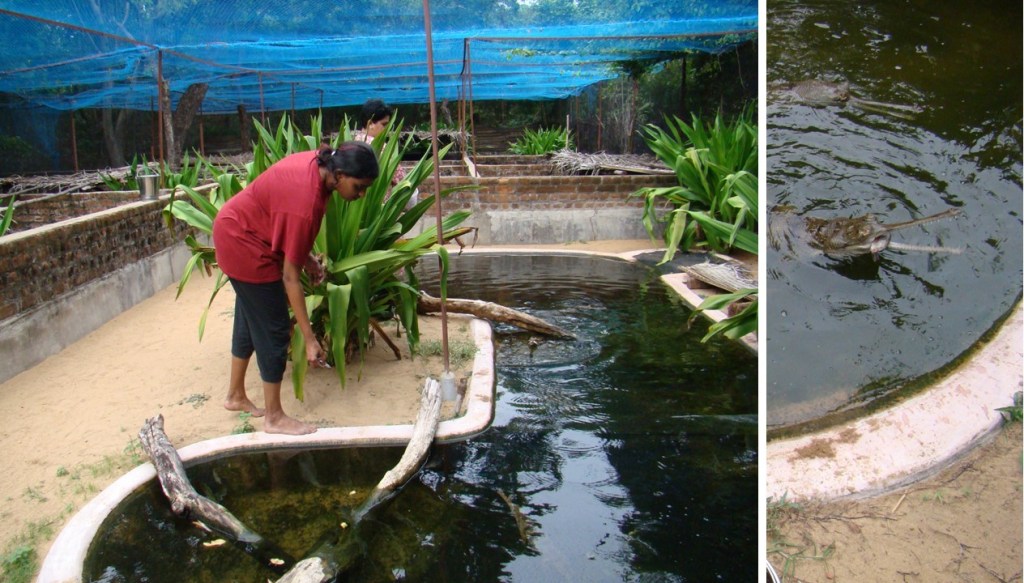
Image: My volunteering at Madras Crocodile Bank Trust (now called The Madras Crocodile Bank Trust and Centre for Herpetology) involved assisting in staff in maintaining the enclosures of crocodiles, sorting and feeding fish to the juvenile Gharials (seen in the right side). I also took children for walks around the park and told them about the exciting life of reptiles.
Volunteering programs almost always begin with a brief training period after which work would be assigned for the rest of the duration of volunteering. In addition to learning about field techniques, having organizational skills, communication skills (being fluent with local language of the area of study), computer skills, prior field experience relating to the intern’s academic interests and ability to work independently, driving, working independently or as part of a team are an added sought after characters in a volunteer. If extensive field in remote areas are part of the work, then its also important that you are physically fit, healthy, and can rough it up on field. For example, surveys in the forest may involve long hours of walking in sun/rain through dense foliage, trekking up and down steep hills or valleys, crossing ridges or ravines, being mobbed by leeches or ticks- all while having to be constantly alert about wild animals.
Read Part 2 of Volunteering Chronicles: Wild heart and helping hands.
Education and Awareness Short Stories #travel 21stcenturyskills charity community conservation donateyourtime donation earthlynotes environmentalpreservation experience fieldexperience fieldnotes fieldwork giveback help interns internship learning lifeskill naturelove natureobservation ngo nonprofit observeandlearn practicalwork skillset support theearthlynotes volunteer volunteering volunteeringisfun volunteeringislearning volunteers volunteerwithNGO volunteerwork wildlifeconservation wildlifewatch

Earthly Notes View All →
My name is Adithi Muralidhar. I am a nature enthusiast based in Mumbai, India.
 Earthly Notes
Very interesting and informative Aditi
Regards Bharti
LikeLike
Thank you!
LikeLike